How to Spot Fake Timeshare Exit Companies

A Common Guide Regarding Timeshare Exit Companies
Time and time again, we continue seeing the same pattern: newly formed timeshare exit companies appearing almost overnight, aggressively advertising for a short period of time, then disappearing just as quickly.
Many of these companies rely heavily on sponsored Google advertisements, yet outside of those ads they are surprisingly difficult to find. They often have little to no social media presence, no Better Business Bureau profile, no meaningful customer feedback, and no long-term reputation whatsoever.
Occasionally, someone online may “swear by” one of these companies in what appears to be a genuine customer recommendation on platforms like Reddit or TUG. However, months later, the same company may have vanished entirely or been exposed for questionable business practices.
So how can you identify potentially suspicious timeshare exit companies before becoming involved?
1. Be Careful With Generic Company Names
Start by considering how you found the company in the first place.
Did you search for a broad term such as:
- “timeshare exit company”
- “cancel my timeshare”
- “timeshare cancellation”
- “timeshare exit strategies”
- “timeshare relief”
In many cases, the first results shown on Google are sponsored advertisements. Some of these companies are legitimate, but many rely almost entirely on paid advertising because they lack any real long-term reputation. Established companies with a recognizable presence usually have verifiable business information attached to them, including public reviews, a consistent address, business registrations, and references outside of advertisements.
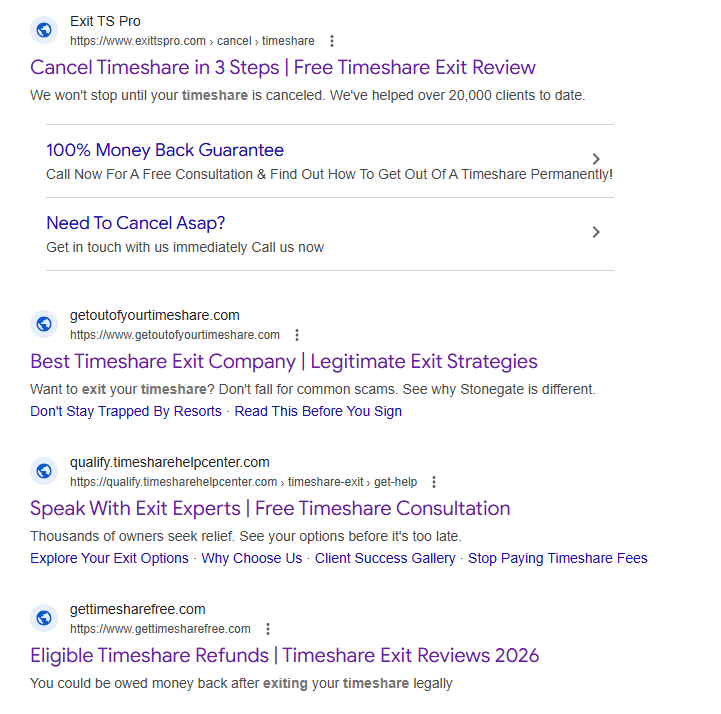
Now let’s say you clicked one of those sponsored links. We’ll use “GetTimeshareFree.com” as an example.
One immediate concern is the lack of an actual identifiable company name. Websites operating under vague phrases such as:
- “Cancel My Timeshare”
- “Timeshare Exit Specialists”
- “Timeshare Cancellation Group”
- “Timeshare Relief Experts”
and similar variations are often suspicious because their names blend directly into generic search terminology. They sound less like actual businesses and more like search engine bait designed specifically to catch people looking for timeshare-related help.
And unless they’re actively paying for sponsored advertisements, they become incredibly hard to find.
2. Verify Reviews and Business Presence
Next, search for independent reviews of the company.
If you search the company name and cannot find verifiable reviews outside of their own website, that should immediately raise concern.
Using our example again, “GetTimeshareFree” doesn’t even sound like a real company name to begin with. And as expected, there are essentially no independent reviews attached to it.

Despite claiming to be “BBB A+ Accredited,” there’s no actual company name listed alongside the claim, nor any direct link leading to the supposed BBB profile.
Ironically, they also showcase logos such as “Forbes,” “CNN,” “ABC News,” and “Fox Business” in one of those “As Seen On” sections — another tactic commonly used by questionable timeshare exit companies to create an appearance of legitimacy.
The more media logos a site throws at you without any actual source, citation, interview, or article attached to them, the more suspicious it starts looking.
A legitimate company should be easy to verify.
You should be able to find:
- A registered business name
- Independent reviews
- A physical office location
- Business records
- A long-term online presence
- Real customer interactions on multiple platforms
Another common tactic involves “in-house” testimonials — reviews that exist only on the company’s own website. These reviews are frequently impossible to verify and may use stock photos, generic names, or vague stories with no supporting evidence. If a company supposedly has hundreds of satisfied clients, yet there are no reviews on Google, Trustpilot, Yelp, Reddit, or the BBB, that discrepancy should not be ignored.
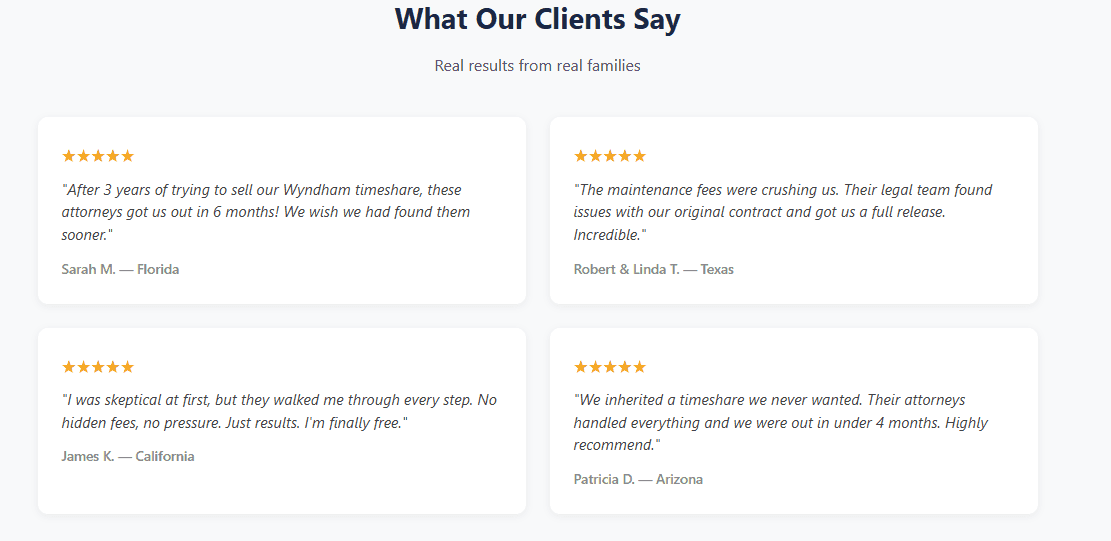
Like in our example, there’s no real online discussion about “GetTimeshareFree,” yet somehow they supposedly have all these happy customers despite no presence on basically anywhere else.
How exactly does an almost unknown timeshare exit firm suddenly have dozens of glowing testimonials that only exist on its own website?
That’s the type of thing people should stop and question.
3. Watch for Other Red Flags
There are several additional warning signs consumers should pay attention to:
- High upfront fees before any work is completed
- Pressure to “act immediately”
- Guarantees that sound unrealistic
- No clear explanation of the cancellation process
- Poorly written or AI-generated articles
- Repeated stock images across multiple pages
- Recently created social media accounts with little activity
- Websites that look identical to other exit companies
- Lack of transparency regarding ownership or staff
Checking the company’s Terms of Service and refund policy is also extremely important.
Some companies heavily advertise “money-back guarantees,” but their actual policies may contain vague conditions or clauses that make refunds extremely difficult to obtain.
The less genuine human presence a site seems to have, the more cautious you should be.
4. Check the Website’s Age and Registration
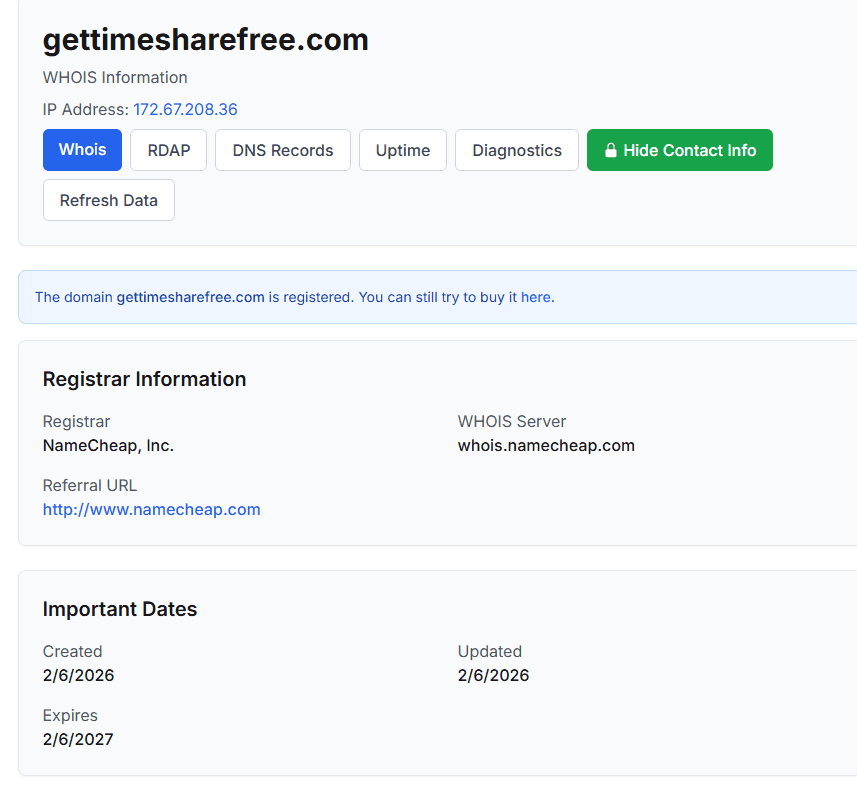
Although not always definitive, checking a website’s domain registration through a WHOIS lookup can sometimes reveal useful information.
Using our example, “GetTimeshareFree.com” was created this very year — February 6th, 2026 — and only registered for a single year.
Why does that matter?
Because one-year registrations are often associated with “dash-and-leave” style operations. The idea is simple: run ads, catch a few victims, collect money, disappear, then repeat the process later under another name and another domain.
After all, a domain may only cost them around $10–20 dollars, while consumers are potentially paying thousands for supposed “timeshare cancellation services” that may lead nowhere.
And once the website disappears, so does your method of contact.
Our example is one of those very obvious cases where making an entire dedicated review almost feels unnecessary, because there are countless other timeshare exit companies operating in this exact same manner.
That’s the entire reason this article was made.
Because there are simply too many of these vague, difficult-to-trace companies appearing constantly: no real information, no legitimate reputation, no meaningful online presence, fake-looking reviews, and little notoriety outside of temporary sponsored advertisements.
So rather than reviewing every single one individually, it’s more useful to teach people what patterns to look for themselves.
If the “new” timeshare exit company you suddenly found through a sponsored ad matches several of these warning signs, then yes — there’s a very good chance you should stay away from it.
Take caution, verify everything independently, and research as much as possible before trusting any company with thousands of dollars.